Future-fit Victoria: Accelerating Productivity Through Innovation & Partnership
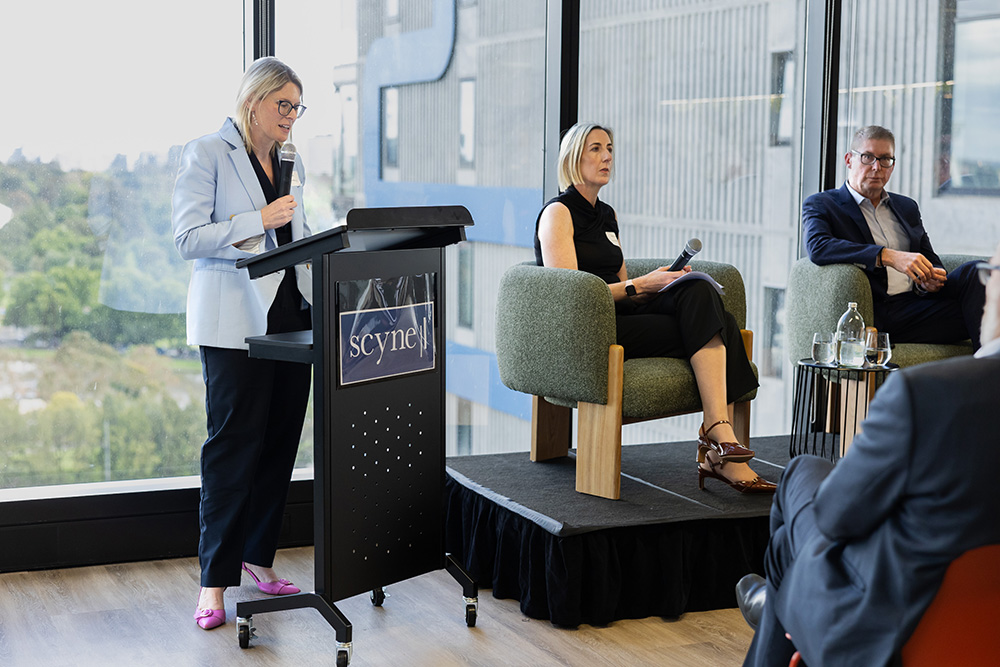
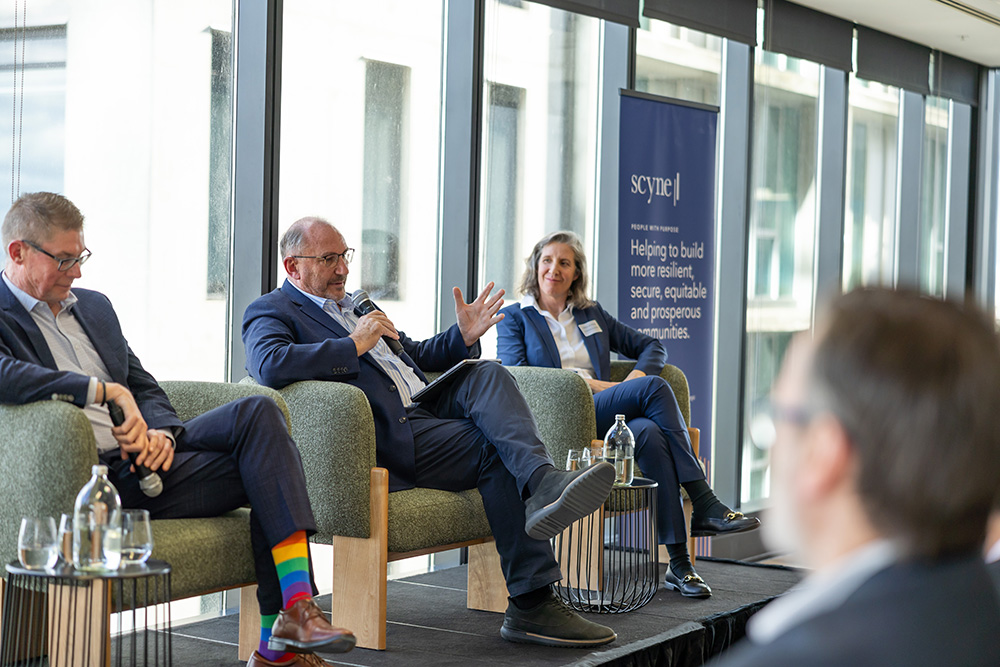
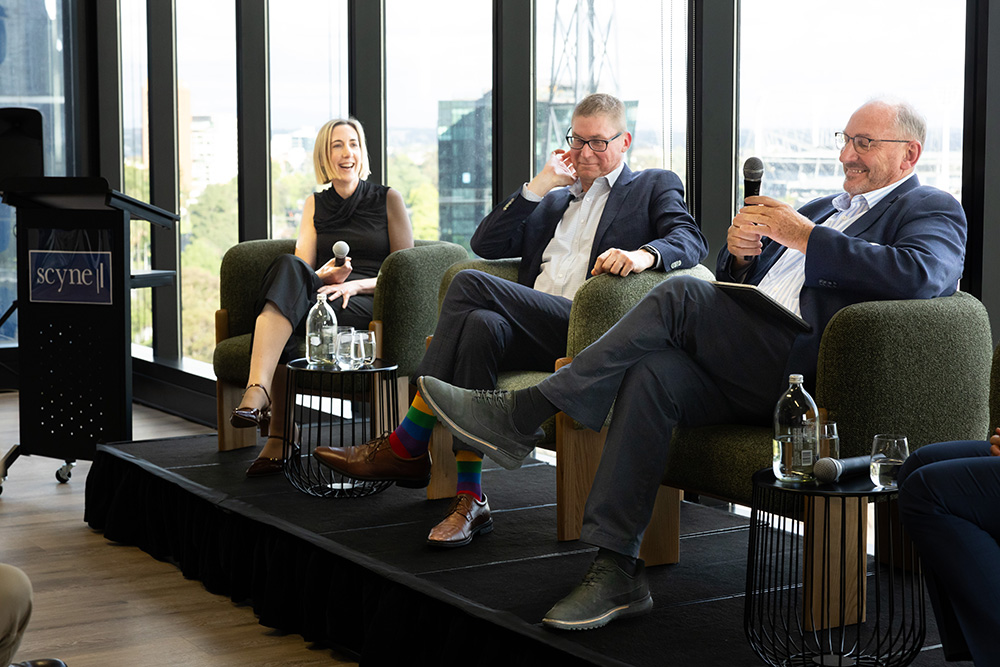
On Monday 1 December, Scyne hosted a full house of public purpose leaders at Scyne’s new Melbourne office for a panel Q&A on how Victoria can lift productivity through skills, innovation and cross sector collaboration.
Huge thanks to our passionate panellists: John Mullen (Chair of Scyne, Qantas, Brambles and Treasury Wine Estates), Catherine de Fontenay (Productivity Commissioner), Terry Symonds (CEO, Berry Street Yooralla) and to our facilitator Emily Roper, Managing Director at Scyne and former Director General, Department of the Premier and Cabinet (DPC) in WA.
Looking out over Birrarung Marr bathed in a golden sunset, our panellists provided insightful views on how we can get Victoria ready for the next chapter in the State’s productivity reform journey.
Key take aways included:
Skills as the cornerstone: There are four productivity levers – business environment, capital investment, skills and innovation – and skills development is critical for Victoria’s service‑led economy to increase the productivity of our local workforce, to innovate and to enable adoption of innovation from overseas
AI’s double edge: There are significant gains alongside real displacement risks from AI and we will need the sort of trilateral compact between businesses, unions and government seen in previous economic reform periods to ensure the gains make the costs worth it
Culture of business innovation: In the private sector, there is a need to foster an entrepreneurial culture that accepts failure as learning towards success and supports startups to be able to retain our most innovative talent
Focus on value not outputs in non-market sectors: In education and care sectors, we have to pivot towards defining and measuring productivity based on value (e.g. outcomes and quality), not just traditional input and output metrics, and
Productivity potential in not-for-profits: In the not-for profit sector, there are real opportunities to lift productivity (e.g. investment in technology and multiskilling) but as price-takers with limited capacity to fund back of house innovation so investment will require difficult trade-offs; and the multiple, parallel regulatory schemes limit benefits that can come from integrated services.
The panel presentations were followed by lively Q&A with the audience, which enabled the panel to further explore:
the challenge employers will face in building skills of new entrants and enabling pathways to mastery in an AI enabled economy where lower skill tasks – previously part of entry roles – will be automated
that when productivity in education and care sectors is measured by reference to outcomes, it encourages consideration of intervening earlier through often lower cost interventions, and
the benefits of productivity can be shared, and there are real examples where the incentives of workers, management and the wider community are aligned – such as cross skilling staff in care roles to improve career pathways, reduce reliance on contingent labour and lift client outcomes; or where automating manual, male dominated industries, both reduces cost to serve and enables a more diverse workforce.
While the discussion offered useful take-aways to everyone that attended, the energy in the room and the networking across government and for-purpose leaders was a highlight.